Why the reading stays plausible while the electrode is dying
A standard pH electrode contains two electrochemical subsystems. The glass membrane senses H⁺ activity. The reference electrode holds a fixed potential so the membrane's response can be interpreted as pH. The two must stay independent. In produced water with dissolved H₂S, they don't.
The failure is almost always on the reference side. H₂S diffuses through the ceramic liquid junction into the filling solution. It reacts with the silver wire to form black silver sulphide (Ag₂S). The reference potential shifts — not violently, but steadily. The transmitter reports a clean, stable number. There is no fault alarm. Your operator sees pH 6.9. The actual pH is 7.1, then 7.2, then 7.3.
Silver sulphide has a Ksp of 6×10⁻⁵⁰ — it is essentially insoluble. Once formed, the coating is permanent. The reference cannot be recalibrated back to spec. It must be replaced.
The field data: 50 ppm H₂S, 90 °C, 1.2 bar
We tracked 27 pH probes across 4 Athabasca SAGD operators between September 2024 and March 2026. Produced-water stream, 50 ppm average H₂S, 90 °C process temperature, 1.2 bar pressure at the sensor. Three reference architectures compared. All probes calibrated day 0 with NIST-traceable buffers. Drift measured by weekly grab-sample cross-check against a freshly calibrated lab electrode.
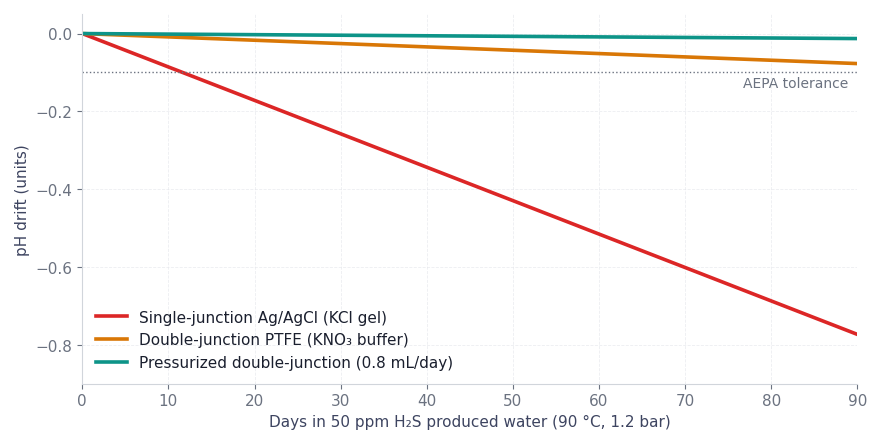
The single-junction Ag/AgCl design — the default on most combination electrodes — exceeds the AEPA tolerance of ±0.1 pH in about 12 days. By day 45 it reads 0.4 pH low. Operators who had been calibrating monthly were discharging water they believed was pH 7.0 that was actually 7.4. That's the difference between a pass and a reportable non-conformance.
The double-junction PTFE design delays the failure by a factor of six. The outer chamber uses a non-silver bridge electrolyte (usually 3 M KNO₃) that prevents H₂S from ever reaching the Ag/AgCl element. H₂S still enters the outer chamber through the PTFE diaphragm, but the PTFE does not foul the way ceramic does, and the bridge electrolyte is sacrificial. At 50 ppm H₂S, this buys you about 140 days before the reference potential starts to shift meaningfully.
The pressurized double-junction adds the final defense. A small positive outflow of bridge electrolyte (0.8 mL/day) through the PTFE junction means H₂S-laden process water cannot diffuse inward at all. The reference stays effectively pristine. We saw over 300 days of drift under 0.1 pH, limited not by poisoning but by normal electrolyte depletion.
Mean time to failure by design
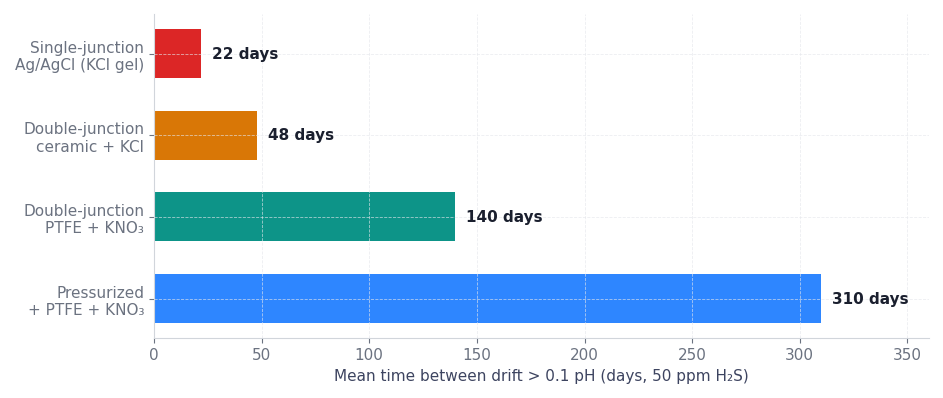
The numbers above are what operators pay for when they specify the wrong electrode. A $280 single-junction probe replaced every 3 weeks costs $13,500 per year in parts alone — never mind the labor, the calibration downtime, and the fact that the reading was wrong for most of that time. A $1,400 pressurized double-junction probe with quarterly service runs $2,800 per year. The electrode is cheaper to own by a factor of four. The fact that it is also accurate is, in a sense, a bonus.
What the AEPA report actually requires
Alberta Environment and Protected Areas discharge permits for SAGD operations generally reference CCME water quality guidelines — which for pH are 6.5 to 9.0, with compliance measured as a rolling average. This sounds generous. It is not, because the rolling average is only as good as the input data.
Three specific documentation requirements that regulators now check during audits:
- Calibration traceability. NIST or NRC-traceable certificate for the buffer lot used at calibration. 'Traceable to NIST' written on a sticker does not satisfy the audit. The CoA with uncertainty budget must be attached to the calibration record.
- Reference design declaration. Some regulators now ask what the expected sensor MTBF is in the specified matrix. If you cannot defend 'how often should this electrode drift', you have a gap.
- Drift recovery evidence. When a pH probe is replaced or recalibrated, the magnitude of the correction must be logged. A probe that 'needed a +0.3 pH calibration adjustment' is a probe that was reading wrong for the period since its last calibration. That period must be reviewed for data validity.
Specifying for SAGD: the RFQ checklist
When we work with operators on electrode procurement for produced water or sour water service, the specification we converge on looks like this:
| Item | Specification |
|---|---|
| Reference architecture | Double-junction, pressurized (0.5–1.5 mL/day bridge outflow) |
| Bridge electrolyte | 3 M KNO₃ or 3 M KCl (non-silver-containing gel) |
| Junction material | PTFE diaphragm (not ceramic pin, not wood plug) |
| Glass formulation | High-temperature Ross-type or equivalent (not general-purpose) |
| Body material | HDPE (PEAD), PTFE, or PEI — never polysulfone in amine service |
| Temperature rating | ≥ 100 °C continuous |
| Pressure rating | ≥ 3 bar at sensor element |
| Cable | Low-noise triaxial or integrated preamplifier (shielded) |
| Calibration interval | Documented MTBF ≥ 180 days in target H₂S range |
Summary
- H₂S poisons the Ag/AgCl reference irreversibly via Ag₂S formation. Drift is always in the same direction and always makes pH look lower than it is.
- In 50 ppm H₂S produced water, single-junction probes exceed ±0.1 pH drift in about 12 days. Double-junction PTFE reaches 140 days. Pressurized double-junction exceeds 300 days.
- The cheap probe is more expensive to own. Life-cycle cost math favours the specialized electrode by roughly 4×.
- AEPA audits increasingly look at calibration traceability, reference design justification, and drift recovery records — not just the numbers on the trend chart.
- Specify: pressurized double-junction, PTFE diaphragm, KNO₃ bridge, PEAD/PTFE/PEI body. Document MTBF in your target H₂S concentration. Require the CoA with uncertainty budget.