What ORP actually measures
An ORP electrode (oxidation-reduction potential sensor) measures the electrical potential generated by the combined redox couples present in the water, referenced against an Ag/AgCl reference. It does not measure free chlorine concentration directly. It measures the water's overall oxidizing capacity, integrated across all species present.
In a drinking-water distribution system, the oxidizing species typically include hypochlorous acid (HOCl), hypochlorite ion (OCl⁻), chloramines (if ammonia is present), dissolved oxygen, and occasionally residual ozone. Reducing species include natural organic matter, residual ferrous ion, sulfide, and nitrite. The measured ORP is a weighted average of all those couples — not a pure free-chlorine signal.
The pH dependence that breaks the ORP–chlorine equivalence
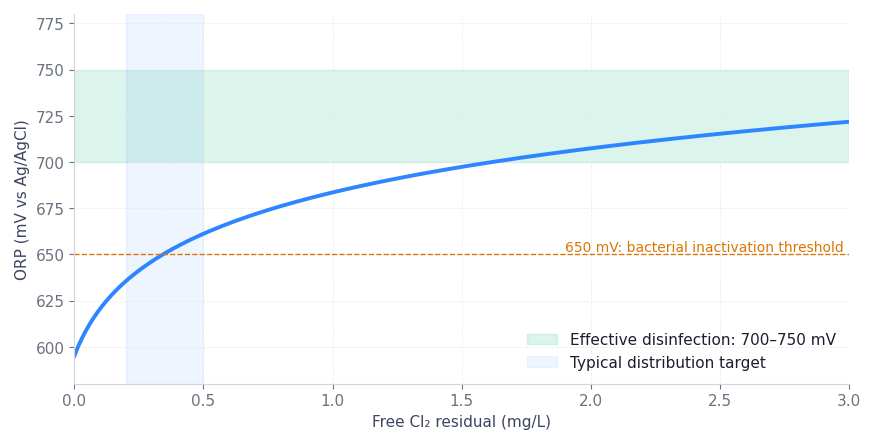
Looking at Figure 1, the relationship between ORP and free chlorine appears straightforward: more chlorine, more ORP. This is correct — at fixed pH. But pH in a distribution system is not fixed; it shifts with coagulant dose, seasonal variation, and stagnation in dead-end mains. The consequence:
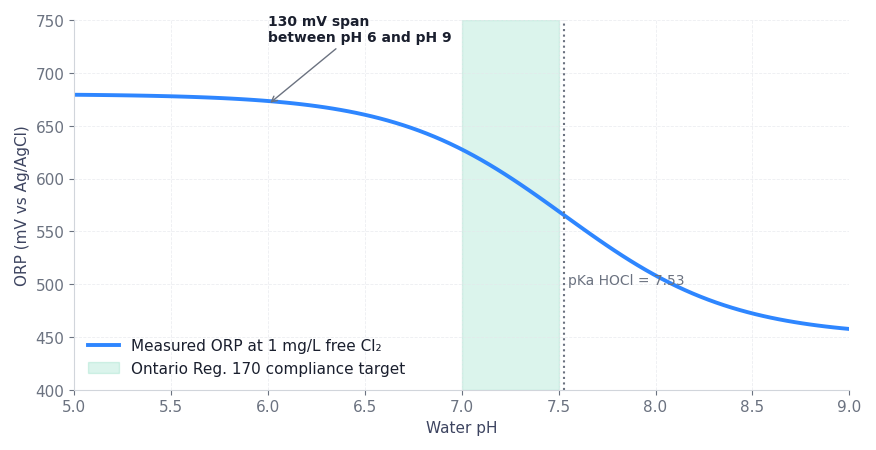
The cause is speciation. HOCl and OCl⁻ are in equilibrium with pKa = 7.53 at 25 °C. Below pH 7.53, HOCl predominates (E° = 1.49 V); above pH 7.53, OCl⁻ predominates (E° = 0.89 V). At constant 1 mg/L total free chlorine, the measured ORP changes 130 mV across the pH range 6 to 9 — entirely because of speciation, not because of concentration.
Ontario Reg. 170/03 — what it actually requires
Ontario Regulation 170/03 (the Drinking Water Systems Regulation) establishes residual chlorine minimums at the distribution system. For chlorine disinfection, O. Reg. 170/03 Schedule 10 requires a minimum free chlorine residual of 0.2 mg/L at the point of entry to the distribution system and 0.05 mg/L at the extremities. The regulation does not prescribe ORP — it prescribes free chlorine residual.
Inspection by MECP (Ministry of the Environment, Conservation and Parks) focuses on the free chlorine reading, not the ORP. An ORP-only monitoring strategy therefore creates a compliance gap: the ORP can read 720 mV continuously while free chlorine occasionally dips below the regulatory threshold at the far end of the distribution network. The paper record looks compliant; the actual compliance is probabilistic.
The architecture that resolves the gap
Primary: amperometric free chlorine analyzer
Amperometric membrane-covered chlorine probes (Clark-type) respond directly to free HOCl crossing a gas-permeable membrane. They are specific to free chlorine (not total oxidants), read out in the regulatory units (mg/L), and are the defensible primary method under O. Reg. 170/03. Typical detection limit 0.02 mg/L; response time 60–120 seconds; calibration against DPD colorimetric at monthly intervals.
Secondary: ORP for fast response + integrity check
ORP retains operational value as a fast-response indicator (< 5 seconds) of gross changes — a coagulation upset, a sudden main break, an intrusion event. The ORP and the amperometric chlorine together provide redundancy: if ORP drops but chlorine stays flat, something non-chlorine changed (organic matter intrusion, for example). If chlorine drops but ORP stays flat, the amperometric probe may have fouled. Cross-referencing the two signals is a simple integrity check.
pH-compensated ORP
Some modern ORP instruments integrate a pH measurement in the same head and apply a compensation to the ORP reading, effectively reporting 'ORP-equivalent-at-pH-7.0'. This normalized ORP value recovers the equivalence with free chlorine for fixed concentrations across the pH operating range. Where instrument platform supports it, pH-compensated ORP is preferable to raw ORP.
Calibration and maintenance for Canadian operators
| Activity | Frequency | Method / Standard |
|---|---|---|
| Zobell solution verification (228 mV) | Weekly | Reference solution at 25 °C; recalibrate if > ±15 mV deviation |
| Electrode platinum polish | Monthly | Alumina 0.05 µm slurry; rinse in DI water; verify with Zobell |
| Full 2-point recalibration | Quarterly | Zobell + cuprocupric (470 mV) or similar secondary standard |
| Reference junction check | Quarterly | Drift > 15 mV over the quarter = replace reference |
| Amperometric Cl₂ probe membrane | Monthly | Inspect for biofilm; replace if opaque or mechanically damaged |
| DPD colorimetric cross-check | Weekly (or each shift) | At sampling station representative of distribution entry |
Summary
- ORP measures integral oxidizing capacity, not free chlorine concentration. In a system with variable pH, the two are not proportional.
- At constant 1 mg/L free chlorine, ORP varies 130 mV between pH 6 and pH 9 due to HOCl/OCl⁻ speciation.
- Ontario Reg. 170/03 requires a free chlorine residual, not an ORP value. ORP-only monitoring creates a compliance gap.
- Primary compliance instrument: amperometric free chlorine analyzer. Secondary for fast response: ORP (or pH-compensated ORP).
- Maintenance cadence: weekly Zobell check, monthly Pt polish, quarterly full recalibration, weekly DPD cross-check.