What an ISE actually measures
An ion-selective electrode responds to activity of its target ion via a Nernstian potential:
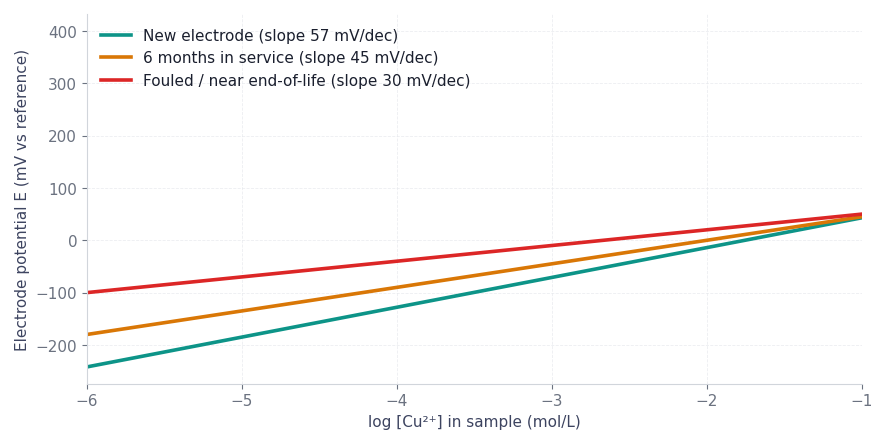
For a copper(II) ISE, z = +2, so theoretical slope is 29.6 mV per decade of [Cu²⁺]. For chloride, z = −1, slope is 59.2 mV per decade. For nitrate (−1), also 59.2 mV per decade. A real electrode's slope drifts from theoretical as the membrane ages or fouls; monitoring slope over time is the single most useful diagnostic of electrode health.
Matrix interference: where the ISE lies
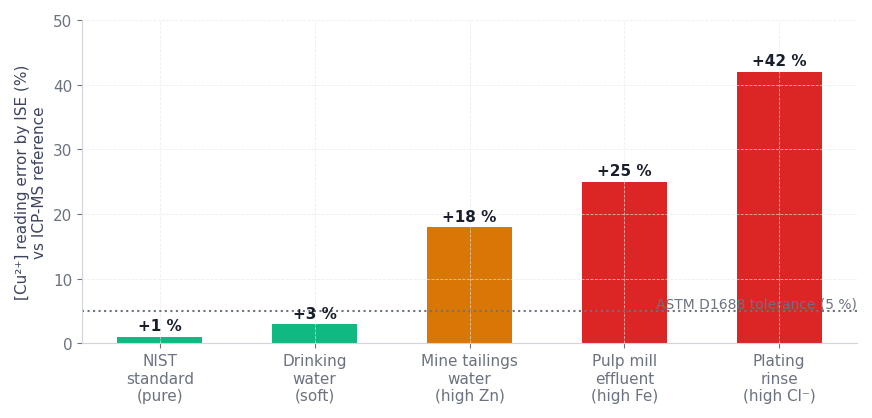
An ISE reports as if the target ion were the only ion in the sample. It is not. Every real sample contains other ions that the electrode's selectivity filter does not fully exclude. The magnitude of error depends on two things: the concentration ratio of interferent to target, and the selectivity coefficient Ki,j for the interferent species.
Copper ISE (CuS-based)
Primary interferents: Ag⁺, Hg²⁺, S²⁻ (all form insoluble sulfides that poison the membrane), Fe³⁺ (displaces Cu on the membrane surface), and to a lesser extent Pb²⁺, Ni²⁺. On Canadian mine tailings and pulp-mill wastewaters, Fe content is often 10–100× the copper content; this produces the +25 % systematic error seen in Figure 2 for pulp-mill effluent. On plating rinse water, free chloride (not normally listed as a Cu ISE interferent) exceeds 10,000 mg/L and shifts liquid-junction potential dramatically, explaining the +42 % reading there.
Chloride ISE (AgCl/Ag₂S-based)
Primary interferents: Br⁻, I⁻, CN⁻, S²⁻, NH₃, organic amines, and sulfur-containing organic molecules. Municipal drinking water is usually a clean matrix for Cl⁻ ISE. Landfill leachate, however, has high ammonia and organic-sulfur content — Cl⁻ readings in leachate routinely run 15–30 % high vs ion chromatography. The ISE remains useful for trend monitoring; it is not acceptable as the primary quantitative method for compliance samples in leachate or industrial wastewater.
Nitrate ISE (quaternary ammonium membrane)
Primary interferents: ClO₄⁻ (massively — KNO3,ClO4 can exceed 1,000), I⁻, Br⁻, SCN⁻, and organic anions with amphiphilic character. Agricultural drainage is usually clean; industrial wastewater from electroplating or explosives manufacture is typically unusable for NO₃⁻ ISE due to perchlorate contamination. This is the interference that catches labs off guard most often — a 1 mg/L ClO₄⁻ in a 10 mg/L NO₃⁻ sample can read as 20 mg/L NO₃⁻.
Sample preparation: the 5-minute step that recovers the ISE
ISA addition (ionic strength adjustment)
Most ISE manufacturers supply an ISA solution to add to samples before measurement. For Cu²⁺, typical ISA is 5 M NaNO₃ + ascorbic acid (Ag removes Ag⁺ interference via reduction; NO₃ swamps background ionic variation). For Cl⁻, ISA is 5 M NaNO₃ alone. For NO₃⁻, ISA is (NH₄)₂SO₄ + borate buffer at pH 3.5. Adding ISA typically brings interference-induced error from 20–40 % down to 3–7 % on typical environmental samples.
Standard addition method
For samples where ISA does not suppress interference to within tolerance, standard addition is the next resort. Measure the sample, add a known spike of target ion, measure again, back-calculate via the Nernst equation. The method cancels out matrix-specific systematic errors. Cost: 3× the measurement time. Benefit: matrix-independent accuracy.
Sample dilution
For high-interferent matrices, a 1:10 or 1:100 dilution with distilled water + ISA can bring interferent concentrations below the threshold where they affect the reading significantly. Dilution requires that the target ion remain above the electrode's lower detection limit (typically 10⁻⁶ M for Cu²⁺, 10⁻⁴ M for Cl⁻, 10⁻⁵ M for NO₃⁻).
When to use ICP-MS instead
For a CALA-accredited environmental lab, the decision tree on ISE vs ICP-MS is roughly this:
| Sample context | Recommended method | Rationale |
|---|---|---|
| Routine drinking water Cu/Cl/NO₃ | ISE + ISA | Clean matrix, low interference, defensible with monthly ICP-MS validation |
| Irrigation / agricultural drainage | ISE + ISA | Usually low interferent; periodic ICP-MS spot-check |
| Municipal wastewater effluent | ISE with standard addition | Moderate interference; ISE acceptable with method QC |
| Landfill leachate, mine tailings | ICP-MS primary; ISE for trend | High interferent; ISE not defensible as quantitative |
| Electroplating/industrial rinse | ICP-MS primary; ISE disabled | Extreme interference; ISE reading is misleading |
| Explosives or perchlorate-bearing | Never NO₃⁻ ISE | Perchlorate interference is catastrophic |
Validation protocol for ISE in an ISO 17025 lab
For CALA-accredited scope using ISE as a quantitative method, the following QC frequency is the baseline we recommend:
- Daily — two-point calibration at expected concentration bracket; slope must be within ±5 % of theoretical to accept.
- Weekly — independent CRM (certified reference material) from an accredited supplier; recovery must fall within 90–110 %.
- Monthly — cross-validation against ICP-MS or IC on a representative fraction of sample types; if bias exceeds method-specific tolerance, investigate before issuing any result.
- Quarterly — electrode slope trend review. If slope has drifted more than 10 mV/decade from commissioning, retire the electrode; do not attempt to compensate in software.
- Annually — formal uncertainty budget review including updated interference assessment per GUM methodology.
Summary
- An ISE is fast and cheap — in some matrices, it is also quantitatively wrong by 40 %. The difference between those situations is the interferent profile.
- Slope drift is the single most useful diagnostic of electrode health. Below 25 mV/decade (for monovalent) or 12 mV/decade (for divalent), retire the electrode.
- ISA addition is the 5-minute intervention that makes most environmental ISE readings defensible. Standard addition is the back-up when ISA is insufficient.
- For CALA labs: ISE with ISA is acceptable for drinking water and agricultural samples. For mine tailings, leachate, and industrial rinses, ICP-MS is the defensible primary method; ISE is trend monitoring only.
- NO₃⁻ ISE in perchlorate-bearing samples is not just inaccurate — it is catastrophically misleading. Disable its use in explosives, electroplating, and any historical industrial waste site.