The three simultaneous failures outside the window
Gold leaching with cyanide is a straightforward reaction:
The rate depends on free cyanide activity and dissolved oxygen. Both are pH-controlled. Below pH 9.5, cyanide protonates to HCN — a volatile gas that leaves the tank, taking reagent with it and producing an occupational exposure issue. Above pH 11.5, the elevated alkalinity precipitates calcium as CaCO₃ which fouls the carbon, and competing ferrocyanide complexes form that lock gold into species the carbon cannot load.
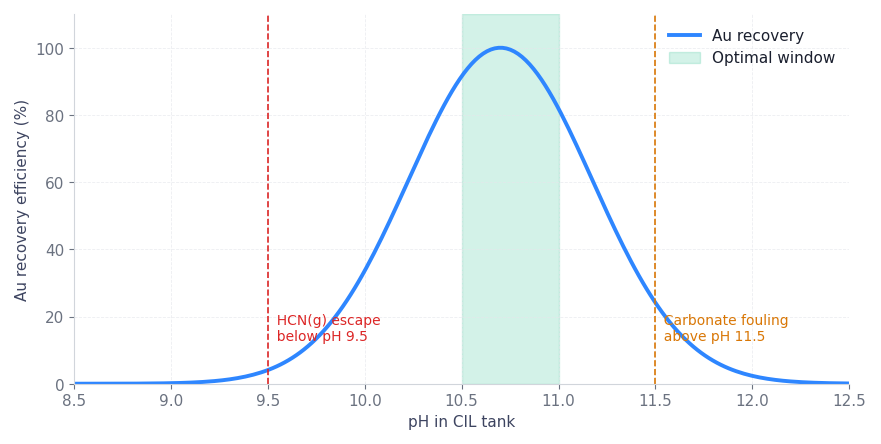
Between 10.5 and 11.0, recovery is within 2 % of the theoretical maximum. Outside that band in either direction, recovery falls off — smoothly at first, steeply after ±0.5 pH from the optimum.
Free CN⁻ dosing: the 0.05 g/L variance that costs money
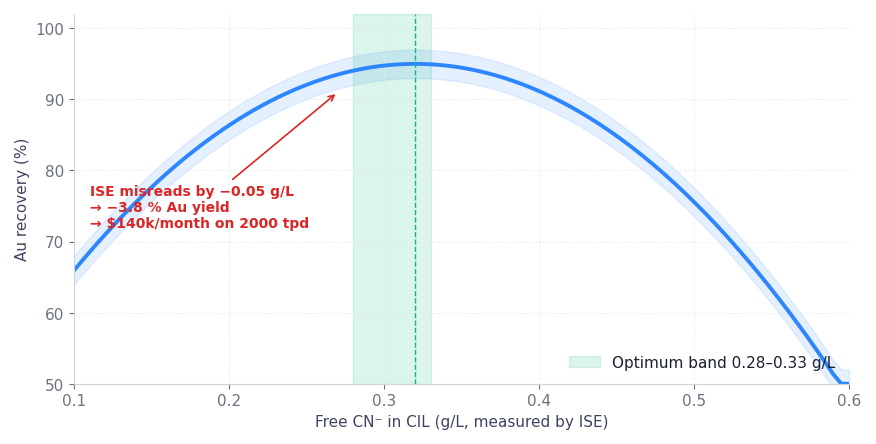
Free cyanide is usually measured by ISE (cyanide-selective electrode) or by silver-nitrate titration. Both methods have real uncertainty; both are sensitive to sample preparation.
On a 2,000 tpd operation running typical Canadian ore grade (2.1 g/t Au, 89 % nominal recovery), a 3.8 % recovery loss is 0.57 kg Au per day, or about $140k USD per month at spot. That number gets the attention of operations managers but rarely the instrumentation budget — which is where it came from.
Why Canadian operations see this worse than most
Ontario and Quebec gold operations share three characteristics that make the measurement harder:
- Cold-ambient feed water. Ore slurries in the Abitibi and Red Lake regions commonly arrive at the leach tank at 4–10 °C. Thermal compensation in the pH electrode has to work across a wide ΔT — and ATC algorithms based on Nernstian-slope correction alone do not capture the temperature dependence of the glass membrane's asymmetry potential.
- High dissolved iron. Sulfide-associated ore bodies leach iron at pH 10.5+. Iron-cyanide complexes (Fe(CN)₆⁴⁻, ferro- and ferri-cyanide) form readily and distort the apparent free-CN⁻ reading on the ISE. The result: your ISE shows less free CN⁻ than is actually available, and operators over-dose.
- Carbonate-hard process water. Recycled process water in Canadian operations accumulates CO₃²⁻ and HCO₃⁻. At pH 10.5+, this buffers against pH changes — but it also scales the glass membrane with CaCO₃ over a few weeks, suppressing the electrode's response. The probe drifts upward (apparent pH > actual) because the alkaline scale on the glass shifts the Donnan equilibrium.
The measurement architecture that handles it
Standard process pH probes in CIL service last about 3 weeks before recovery falls noticeably. Good ones last 6 months. The differences are architectural:
| Feature | Standard (3 weeks) | CIL-grade (6 months) |
|---|---|---|
| Glass membrane | General-purpose high-pH | Slurry-specific alkaline-resistant |
| Reference junction | Ceramic pin (clogs) | PTFE annular or open sleeve |
| Reference filling | Gel (static) | Liquid with 0.2–0.5 mL/day outflow |
| Electrode body | Polysulfone or PVDF | HDPE or PEEK, shock-resistant to ore impact |
| Temperature comp. | NTC thermistor in probe tip | Dual thermistor (probe + body) |
| Cleaning strategy | Manual weekly | Ultrasonic auto-clean on schedule |
The CIL-grade probe costs 3–4× the standard. It lasts 8× longer and measures accurately the whole time. The cost per reliable data day is lower by a factor of two, and that calculation does not include the recovery value of accurate pH control.
Free-CN⁻ measurement: ISE vs titration vs online photometric
For daily production records and CIL control, three options exist:
ISE (cyanide-selective electrode)
Fast response (seconds), online-capable, low cost. Interferes with dissolved iron, copper, and free sulphide. Works well in 'clean' operations (silicate host rock, low Fe) — poorly in sulfide-ore operations without sample conditioning. Required sample prep: NaOH addition to fix pH at 12+, lead nitrate to precipitate sulphide, air purge to strip HCN.
Silver-nitrate titration (AgNO₃)
Classical reference method. Manual, slow (10–15 min per sample), but low interference when sample is prepared. Canadian operations typically run 4–6 titrations per shift as a check on online ISE. The titration remains the defensible audit record; the ISE is the operational feedback signal.
Online photometric
Colorimetric methods (pyridine-barbituric acid, CN-selective reagents) read out in real time via flow-through cell. Higher capital cost; less interference than ISE. Appropriate for operations above 5,000 tpd where the recovery value justifies the instrumentation. Becoming more common in Canadian operations above 4 g/t grade.
The control strategy that keeps you in the window
Three-loop control, from slowest to fastest:
- Lime addition (pH) — slow loop, 5-min deadband. Use the tank-average pH, not the probe nearest the lime inlet. Short-cycle dosing fails because lime takes minutes to fully dissolve and mix.
- CN addition — medium loop, hourly adjustment. Feed-forward on ore tonnage and feed grade; feedback from online ISE or shift titration. The ISE is the controller input when sample conditioning is working; the titration is the sanity check.
- Air/oxygen sparge — fast loop, continuous. DO setpoint typically 6–8 mg/L. Above 10 mg/L is wasted reagent; below 4 mg/L starves the reaction. DO probe must be membraned (polarographic or luminescent), not galvanic, for lifetime.
Summary
- The CIL pH optimum is 10.5–11.0. Outside this 0.5 pH band, recovery degrades steeply. Most operations run slightly inside it; the 'slightly outside' part is where recovery value leaks.
- A 0.05 g/L miscalibration on free CN⁻ can cost $140k/month on a 2,000 tpd Canadian operation. The instrumentation that fixes the problem costs less than one month of that loss.
- Canadian operations face specific challenges: cold feed water, high Fe-CN complexes, carbonate scaling of glass. Standard process probes fail in 3 weeks; CIL-grade probes in 6 months.
- Specify HDPE/PEEK body, PTFE annular reference junction, liquid filling with managed outflow, dual thermistor ATC.
- Run three-loop control: lime for pH (slow), CN for free cyanide (medium), air for DO (fast). Use ISE online with shift titration as audit trail.