The problem: what chloride does to a pH reading
The physics is straightforward and textbook. The reference electrode of a pH probe maintains its potential via the Ag/AgCl equilibrium inside the filling solution. The electrochemical contact to the sample is made through the liquid junction — typically a ceramic pin, a PTFE sleeve, or a gel plug. That junction is where a small amount of KCl from the filling solution diffuses out and a small amount of sample ions diffuse in.
When the sample contains a lot of chloride, two things happen:
- Asymmetric diffusion. Chloride in the sample slows the outward diffusion of KCl from the filling solution. The ionic distribution at the junction shifts, creating a non-zero residual junction potential.
- Silver-chloride precipitation at the junction. Elevated Cl⁻ drives AgCl precipitation inside the junction, partially blocking the ion-exchange path. This increases junction resistance and produces slow, temperature-sensitive drift.
Both effects scale with [Cl⁻] and with how 'efficient' the junction is at keeping the two solutions separated. A generous, open junction (ceramic pin with constant small flow of KCl outward) minimizes the problem. A 'maintenance-free' gel junction — the kind shipped in inexpensive probes for water-utility markets — has essentially no way to handle the ingress.
The numbers: how much error, in which architecture
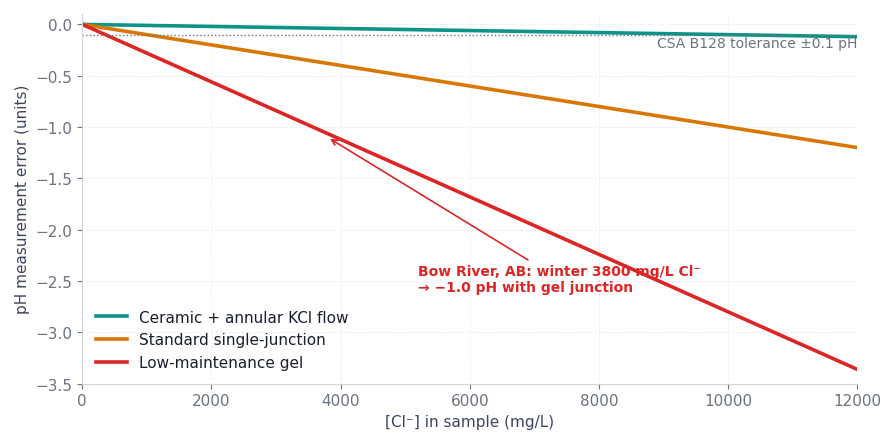
The gap between a well-specified process electrode and a 'maintenance-free' gel-junction probe is dramatic at high chloride. At 3,800 mg/L Cl⁻ — the Bow River winter peak — the gel-junction probe reads 1.0 pH below actual. The ceramic/PTFE architectures stay inside CSA tolerance across the full range we tested.
Canadian seasonal chloride: the data
![Figure 2. Monthly [Cl⁻] in raw water for three Canadian utilities over 2024–2025. Winter peaks exceed 3 × the CCME aesthetic objective.](chloride_seasonal.png)
Three regional patterns worth noting:
- Calgary (Bow River). Typical summer 250 mg/L; winter peak above 1,100 mg/L. The Bow drains a large urban catchment; winter sand-salt mix on arterial roads produces direct runoff.
- Laval, QC (Rivière des Prairies). Summer background near 500 mg/L; winter peaks above 3,400 mg/L. Quebec municipalities use larger salt volumes per lane-km than most Canadian averages, and the watershed is small.
- Hamilton, ON (Lake Ontario). Lake intakes buffer the salt pulse; summer 150 mg/L, winter peak near 310 mg/L. Lake-sourced utilities see the problem but rarely above CCME limits.
What CSA B128 actually requires
CSA B128.1-19 (and its update cycle) is the Canadian standard for waterworks calibration and measurement. For pH specifically, §8 requires routine measurement calibration traceable to NIST-equivalent primary buffers, with stated measurement uncertainty. The aesthetic objective for pH at the tap (Health Canada Guidelines for Canadian Drinking Water Quality) is 7.0 to 10.5 — wide. But the operational range for coagulation pH (typically 6.3 to 7.5 for alum-based coagulation, 8.5 to 9.0 for soda-ash precipitation) is narrow.
A probe reading 1.0 pH low in winter has two possible audit outcomes. The regulator either concludes the plant is running out-of-spec on coagulation pH (operational violation), or the plant adjusts the target to compensate and is then running out-of-spec on aesthetic pH at the tap (distribution violation). Either direction is a reportable finding.
The specification that survives a Canadian winter
| Parameter | Specification |
|---|---|
| Reference junction | Ceramic annular with continuous KCl flow, or PTFE sleeve |
| Junction flow rate | 0.2–0.8 mL/day (pressurized or gravity-fed) |
| Filling solution | 3 M KCl saturated with AgCl (not low-maintenance gel) |
| Body material | HDPE (PEAD) or PEI (Ultem®) |
| Temperature compensation | Pt-1000 integrated; calibrated across 0 °C to 25 °C |
| Calibration interval (winter) | Weekly during November–March; monthly otherwise |
| Buffer set | NRC-traceable, matched for cold calibration (pH 4.01 and 10.01 at 5 °C) |
Summary
- Chloride interferes with pH measurement through asymmetric diffusion at the reference junction and through AgCl precipitation inside the junction.
- At Canadian winter chloride loads (1,100 mg/L in Calgary, 3,400 mg/L in Laval), gel-junction 'maintenance-free' probes read 0.5 to 1.5 pH below actual — enough to break CSA B128 and Health Canada aesthetic objectives in either direction.
- Ceramic or PTFE junctions with active KCl outflow stay inside ±0.1 pH across the full chloride range.
- Winter calibration must use temperature-matched buffer values; 25 °C buffer pH is not 5 °C buffer pH.
- Specify: annular ceramic or PTFE junction, 3 M KCl with active outflow, HDPE/PEI body, Pt-1000 ATC, NRC-traceable buffers with cold-temperature CoA values.